The Paperwork War: How One Missouri Town Accidentally Sued the Wrong State and Still Came Out Ahead
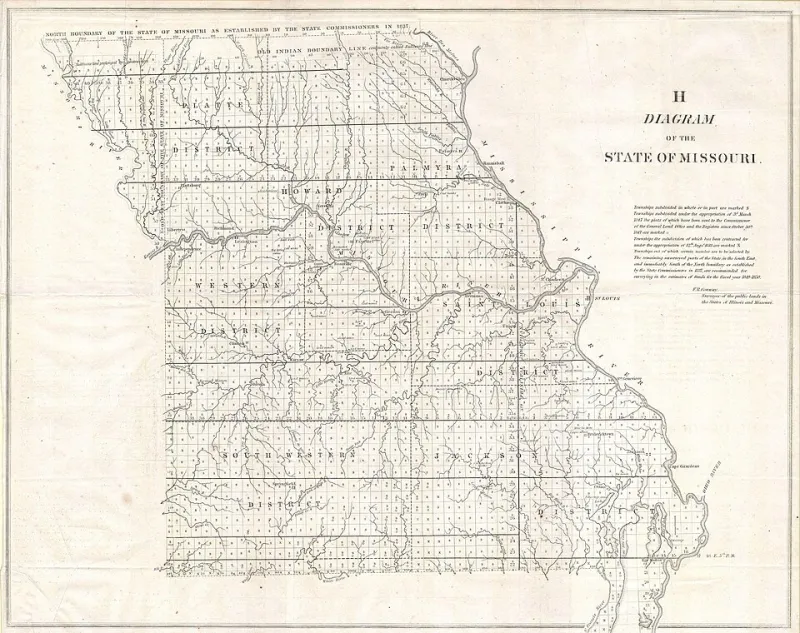
Photo: http://www.geographicus.com/mm5/cartographers/landoffice.txt, Public domain, via Wikimedia Commons
If you ever need proof that bureaucratic incompetence can occasionally work in your favor, look no further than a forgotten corner of the Missouri border and one of the most spectacularly misdirected legal disputes in American territorial history. This is the story of a town that picked the wrong fight, with the wrong state, for the wrong reasons — and somehow walked away with more land than it started with.
A Survey Gone Sideways
In the decades following the Civil War, the American interior was still being carved up, catalogued, and argued over. State borders that looked clean on federal maps were often fuzzy in practice — the result of rushed surveys, inconsistent measurements, and the general chaos of westward expansion. Boundary disputes were common. What was not common was filing your boundary dispute against a state that had nothing to do with your problem.
The town in question — a small agricultural community sitting near the Missouri-Kansas line, referred to in historical records as Caldwell's Crossing — had a legitimate grievance. A strip of farmland along its western edge had been incorrectly surveyed in the 1870s, leaving roughly 200 acres in legal limbo. Local landowners believed the acreage belonged to Missouri. Kansas, whose border abutted the disputed strip, disagreed.
In 1881, the town's appointed land agent — a man described in county records as "diligent but occasionally confused" — prepared the formal legal complaint and dispatched it to the appropriate state authority.
Except he sent it to Iowa.
The Wrong Envelope, the Wrong Desk, the Wrong State
Exactly how the misdirection happened has never been fully explained. The most widely accepted theory among the historians who have studied this case is that the land agent was simultaneously managing a separate, minor correspondence with an Iowa land office regarding an unrelated property matter, and that in the process of preparing multiple documents, he addressed the Missouri-Kansas grievance to the Iowa State Land Commission instead of its Kansas equivalent.
Iowa, to its credit, did not immediately throw the letter away. Iowa's land commissioners read it, recognized that it made no geographic sense whatsoever, and wrote back asking for clarification.
The land agent, apparently not realizing his error, clarified — in a follow-up letter that contained additional legal arguments, supporting documents, and a hand-drawn map that was, unfortunately, also mislabeled.
At this point, Iowa was in possession of a fairly substantial legal filing from a Missouri town claiming disputed territory that Iowa had no connection to. The sensible response would have been to return everything with a polite note. Instead — and this is where things get genuinely strange — Iowa forwarded the matter to its state attorney general's office, which appears to have begun processing it as an actual inter-state land query.
A Decade of Magnificent Confusion
What followed was roughly ten years of compounding bureaucratic disorder. Missouri, noticing that its border community had filed some kind of grievance but uncertain of the details, began its own internal review of the disputed acreage. Kansas, which had never received the original complaint, remained unaware that it was nominally the subject of a legal action. And Iowa continued to correspond with Caldwell's Crossing about a territorial matter that was, geographically speaking, several hundred miles away from Iowa's borders.
By the late 1880s, the situation had attracted enough attention within Missouri's state government that a formal legislative inquiry was launched. The inquiry's findings were, in the words of the committee chairman's report, "difficult to summarize with precision." The disputed land had been reviewed by at least four separate surveying parties, two of which had produced contradictory results. Missouri had a pending claim with Iowa over land that Iowa didn't own. Kansas still didn't know any of this was happening.
Legal historians who have examined the surviving documents describe the paper trail as "extraordinary" — not because of any sophisticated legal maneuvering, but because of the sheer volume of official correspondence generated by a mistake that should have been caught in week one.
The Accidental Victory
The resolution, when it finally came in 1891, was almost as strange as the dispute itself. A federal land mediator brought in to untangle the mess determined that the original 1870s survey had indeed been incorrect, and that the disputed acreage rightfully belonged to Missouri landowners. This was, more or less, what Caldwell's Crossing had been arguing all along.
But the mediator's report also noted that Iowa, in the course of its decade-long accidental involvement, had expended considerable administrative resources processing a claim it had no jurisdiction over. As a goodwill gesture — and possibly to make the whole embarrassing situation go away — Iowa agreed to release a small parcel of unrelated federal land it held in trust, transferring it to Missouri as a form of compensatory settlement.
Missouri, meanwhile, resolved the original Kansas boundary question separately, through a straightforward survey correction that took about three weeks.
The net result: Caldwell's Crossing received clear title to its disputed acreage and an additional land grant from a state that had never been involved in the original disagreement. It is, by any measure, one of the most accidental territorial victories in the history of American land law.
Why This Story Still Matters
Legal historians point to the Caldwell's Crossing case not because it changed any laws — it didn't — but because it illustrates how profoundly the 19th-century American legal system could be driven off course by a single misdirected document. In an era before standardized interstate communication protocols, a misaddressed envelope could set in motion a decade of official action involving multiple state governments, federal mediators, and untold hours of bureaucratic labor.
Also, it's just deeply satisfying to know that somewhere out there, a town accidentally sued the wrong state and ended up better off for it. Sometimes the paperwork works in your favor. Even when — especially when — you have no idea what you're doing.