Lost and Found: The Surveyor's Math Error That Accidentally Saved 300,000 Acres of American Wilderness
Lost and Found: The Surveyor's Math Error That Accidentally Saved 300,000 Acres of American Wilderness
There's a version of American conservation history where visionary leaders drew bold lines on maps and declared wild places worth saving. And then there's the version where a government surveyor made an arithmetic mistake, filed the wrong numbers, and accidentally left 300,000 acres of old-growth wilderness off the books for decades while the timber industry cleared everything around it.
Both versions are true. The second one just doesn't get put on plaques.
The Era When the Government Was Basically Giving Land Away
To understand how this happened, you have to understand what federal land management looked like in the decades following the Civil War. The United States government controlled vast tracts of territory across the West and Midwest, and the prevailing philosophy was essentially: measure it, categorize it, and get it into private hands as fast as possible. Land was being surveyed, parceled, and transferred at a pace that prioritized speed over precision.
Federal surveyors were responsible for establishing the legal boundaries of public land using a grid system of townships and ranges. It was methodical work, but it was also physically grueling — done on foot, in remote terrain, with instruments that required careful calibration and mathematical calculations done by hand in field notebooks. Errors happened. Most were minor. Some were not.
In the late nineteenth century, a surveyor working through a particularly rugged stretch of land made a calculation error significant enough to shift his recorded boundary lines by a meaningful distance. The practical result was that a substantial block of land — heavily forested, ecologically rich, and sitting in a region that was rapidly attracting logging and agricultural interests — was effectively miscategorized. Some accounts suggest it was recorded as already-surveyed land belonging to an adjacent parcel. Others indicate it simply fell into a gap between survey sections, appearing in no official ledger as available, claimed, or even existing in its correct location.
Either way, the land disappeared from the government's functional awareness. Nobody logged it. Nobody homesteaded it. Nobody applied to buy it, because as far as the paperwork was concerned, there was nothing there to buy.
Decades of Accidental Protection
While surrounding acreage was cleared, developed, and transformed over the following decades, this misplaced wilderness sat untouched. Not because anyone was protecting it — but because nobody knew where to find it on paper, and in the pre-satellite era, land that wasn't on the right documents might as well have been invisible to the machinery of commerce and development.
Local communities near the area were aware the land existed, of course. Hunters knew it. Fishermen knew it. People who lived nearby could see it. But without clear title or survey records that matched the physical terrain, the land existed in a kind of legal fog that kept it off the market and out of development plans.
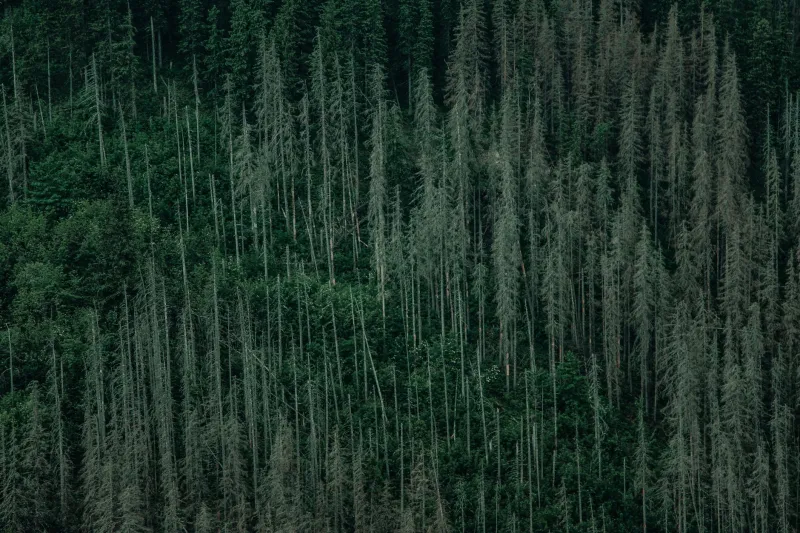
By the time federal land administrators began working through the backlog of nineteenth-century survey discrepancies — a project that accelerated in the early twentieth century as conservation policy began shifting — the land had been left alone long enough to become something genuinely remarkable. Old-growth timber that would have been harvested generations earlier was still standing. Watersheds that would have been disrupted by logging operations were intact. Wildlife populations that had been pressured out of surrounding areas had, in some cases, found refuge in this accidental sanctuary.
The Bureaucratic Gymnastics of Admitting Nothing
Here's where the story takes a turn that feels very on-brand for American government: when officials finally confronted the discrepancy, the question of what to do with the land became tangled with the question of how to explain that they'd lost it.
Admitting publicly that a surveying error had left hundreds of thousands of acres unaccounted for was not an appealing option. It raised uncomfortable questions about what else might be missing from federal land records. It invited legal challenges from timber and agricultural interests who would argue the land should be opened for development now that it had been found. And it put Congress in the position of having to either defend a mistake or pretend it wasn't one.
The solution, arrived at with the kind of quiet efficiency that Washington occasionally manages when embarrassment is the alternative to competence, was to simply designate the land as protected without dwelling too long on why it had never been developed in the first place. Conservation legislation of the era provided enough cover to frame the protection as a proactive decision rather than a retroactive cleanup. The land was absorbed into the federal protected system with language that emphasized its ecological value rather than its administrative history.
The surveyor's error was never formally acknowledged in any congressional record. The land just became protected. Case closed.
A Happy Accident With a Complicated Legacy
The outcome was genuinely good for the land and for the ecosystems it contained. Researchers and naturalists who have studied the area note that its ecological integrity — the result of decades of unintentional isolation — made it scientifically valuable in ways that deliberately protected land sometimes isn't, simply because it had never been partially developed before the boundaries were drawn.
But the story is also a reminder that American conservation history is messier than the mythology suggests. Not every protected wilderness was saved by a visionary fighting against the odds. Some of it was saved by a man who added up a column of numbers wrong in a field notebook on a cold afternoon in the nineteenth century, filed his report, and moved on to the next job.
The wilderness didn't know the difference. It just kept growing.