A Suicide Note Sat in an Evidence Box for Half a Century. Then a Typewriter Gave Up the Truth.
The Note That Should Have Closed the Case
In the autumn of 1971, a small-town bookkeeper in rural Ohio was found dead at her kitchen table. A typewritten note sat beside her, two short sentences explaining she couldn't go on. The local coroner ruled it a suicide before the week was out. The file was sealed. The case was closed. And for nearly five decades, nobody questioned any of it.
Then, in 2018, a retired sheriff's deputy named Gerald Marsh decided he had too much time on his hands.
Marsh had spent 30 years in law enforcement and was the kind of man who took unsolved things personally. He'd started volunteering with a regional cold case unit in eastern Ohio — one of dozens of informal civilian-assisted programs that cropped up across the country as DNA technology and digital records made old evidence suddenly worth a second look. He wasn't looking for anything specific when he pulled the bookkeeper's file. He just pulled it because it was thin, and thin files, in his experience, meant someone hadn't looked hard enough the first time.
The Machine with a Fingerprint
What Marsh noticed wasn't dramatic. It wasn't a bloodstain or a missing witness. It was a letter.
Specifically, it was the lowercase letter e in the word "tired," the first word of the second sentence in the suicide note. The e was ever so slightly elevated — riding about a half-millimeter above the baseline of the other letters. It was the kind of detail you'd only notice if you were looking for it, or if you'd spent decades staring at documents.
Marsh had seen that before. He just couldn't immediately remember where.
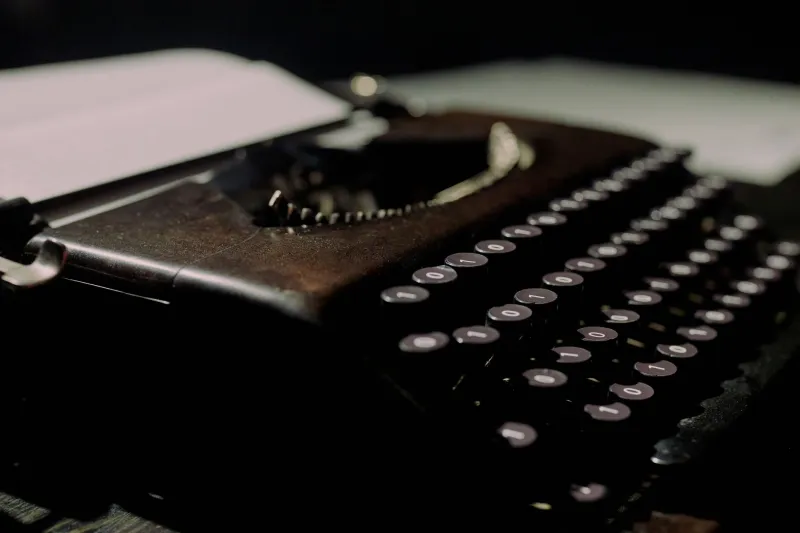
Typewriters, for all their mechanical uniformity, are surprisingly individual. Each machine develops its own quirks over time — a sticky key here, a worn typehead there, a platen that drifts slightly left. Forensic document examiners have known since at least the 1950s that a specific typewriter can be identified by its output the same way a person can be identified by their handwriting. The elevated e, the uneven ink distribution on certain letters, the faint ghost of a smudged t — these are as distinctive as a fingerprint.
The science is called questioned document examination, and while it sounds like something from a Victorian detective novel, it's been used in real American courtrooms for over a century.
A Match That Shouldn't Have Been Possible
Marsh spent three weeks cross-referencing the note against other documents in the county's cold case archive. He wasn't sure what he was looking for. He was mostly eliminating possibilities.
Then he found it.
In a separate file — a 1968 fraud investigation involving a local real estate firm — there were several typewritten letters submitted as evidence. The fraud case had been dropped when the primary suspect died before trial. But the documents were still there, preserved in manila folders, slightly yellowed at the edges.
The elevated e was identical. The ghost smudge on the t matched. The ink distribution pattern on the capital H was the same.
The suicide note and the 1968 fraud documents had been typed on the same machine.
The problem was that the fraud suspect — a local property developer with a reputation for sharp dealings — had died in 1969. Two years before the bookkeeper's death. His office had been cleared out. His equipment had been sold, donated, or discarded.
But someone had used his typewriter in 1971 to write a dead woman's final words.
What the Archive Eventually Revealed
Marsh brought his findings to the Ohio Bureau of Criminal Investigation, where a certified forensic document examiner confirmed the match. The analysis identified at least nine distinct mechanical characteristics shared between the two document sets — well above the threshold typically required to establish a common origin.
The investigation that followed turned up a paper trail that had been sitting in plain sight for decades. The bookkeeper had worked briefly for the real estate firm in the late 1960s. According to records uncovered during the renewed inquiry, she had been a witness — though never formally interviewed — in the original fraud case. Several people who knew her at the time told investigators she had mentioned, more than once, that she knew things about the firm's dealings that made her uncomfortable.
She had never been called to testify. The case had collapsed before it got that far.
The developer's estate had long since been settled. No surviving member of the firm was still alive to face charges. The case was officially re-classified as an unsolved homicide, but no prosecution followed — there was no one left to prosecute.
Why This Story Still Matters
It would be easy to read this as a tragedy without resolution, and in some ways it is. A woman died. Decades passed. The people responsible are gone.
But the story of how the case cracked open is worth sitting with. It wasn't DNA. It wasn't a confession or a deathbed letter. It was a slightly elevated letter e on a machine that nobody thought twice about in 1971.
Forensic document examination remains one of the quieter corners of criminal investigation — less cinematic than fingerprinting, less talked-about than ballistics. But it has resolved cases involving everything from forged wills to fake ransom notes to disputed historical documents. The typewriter, that clunky artifact of the 20th century office, turns out to be one of the most reliable witnesses in the room.
It just takes someone patient enough to listen to it.
Gerald Marsh, for the record, went on to review 14 more cold case files before the county formally expanded its civilian review program. He found anomalies in three of them. Two are still under active review.
The third one, he says, is almost there.