Her Grandmother's Cookbook Had a Secret Ingredient Nobody Expected: A World War II Spy Network
It Started With a Pot Roast
Margaret Holloway wasn't looking for a mystery. She was looking for her grandmother's pot roast recipe.
It was 2009, and she had just finished settling the estate of her grandmother, Elsa, who had emigrated from Belgium to Pennsylvania in 1951 and spent the next five decades being, by all accounts, a perfectly ordinary woman who made excellent food and didn't talk much about the war.
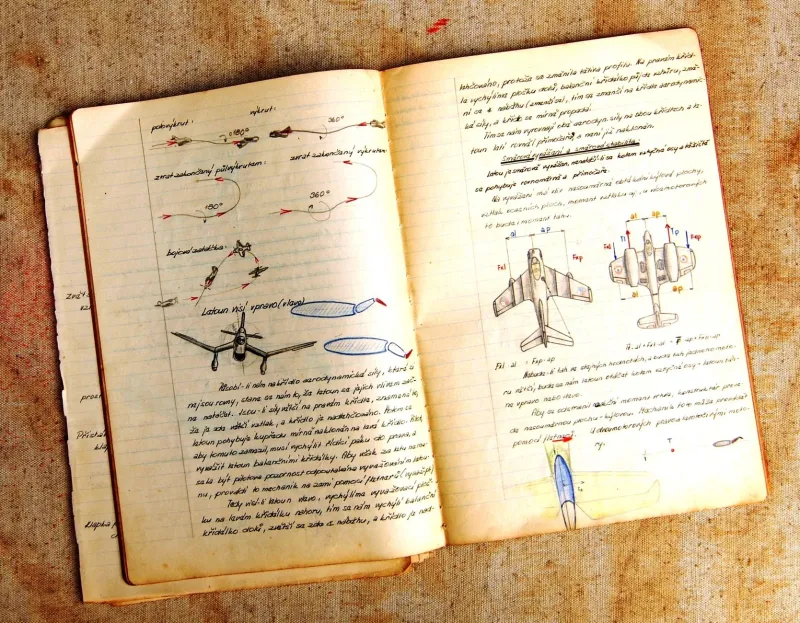
Among Elsa's belongings was a handwritten recipe journal — the kind of thing you'd expect from a woman of her generation. Cloth cover, water-stained pages, recipes in careful cursive for soups and stews and things involving lard that nobody makes anymore. Margaret took it home mostly for sentimental reasons.
Then she started actually reading it.
Something Was Off About the Margins
The recipes themselves were unremarkable. But the handwritten annotations in the margins — additions, corrections, little notes that looked at first glance like cooking tips — were strange in ways that were hard to articulate.
Some were straightforward enough: "use less salt in summer" next to a brine recipe. But others didn't track. A note beside a bread recipe read: Thursday, 14:00, the mill at Fleurus, ask for the man with the blue scarf. A soup recipe had coordinates written in the corner — not GPS coordinates, but the kind of grid-reference notation used on military maps. A dessert entry had what appeared to be a list of surnames, each followed by a single letter.
Margaret, who worked as a librarian, recognized the coordinates notation from her work with historical documents. She also recognized that what she was looking at didn't belong in a cookbook.
She started making calls.
The Cookbook as Cover
What Margaret eventually pieced together — with help from a historian at the University of Pennsylvania and later from archivists at a Belgian war memorial organization — was that Elsa's cookbook had served a very specific purpose during the German occupation of Belgium between 1940 and 1944.
Elsa had been, in her twenties, a low-level courier for a Belgian resistance network operating in the province of Hainaut. The network moved downed Allied airmen through a series of safe houses toward neutral Spain — a route known generically as an escape line, of which several operated across occupied Western Europe during the war.
Couriers like Elsa needed to carry information: meeting times, locations, contact names, route checkpoints. Carrying a piece of paper with that information written in plain text was a death sentence if you were stopped and searched. So the network encoded it.
A handwritten recipe journal carried by a young woman was, to a German soldier conducting a checkpoint search, exactly what it appeared to be. Nobody looked twice at a cookbook. And the annotations in the margins — the times, the coordinates, the names — were written in a system simple enough to be memorized but opaque enough to be meaningless to anyone who didn't already know what they were looking at.
The Code Wasn't Complicated. It Didn't Need to Be.
This is one of the more fascinating aspects of wartime resistance tradecraft: the codes used by ordinary civilians weren't the sophisticated cryptographic systems employed by military intelligence. They didn't need to be.
The goal wasn't to defeat a supercomputer. The goal was to defeat a bored soldier at a checkpoint who had thirty seconds to decide whether to wave you through or drag you in for questioning. For that purpose, a note that looked like a cooking tip was more effective than any cipher.
The system Elsa's network used was a simple substitution layered over geographic references that would only make sense to someone already familiar with the local landscape. "The mill at Fleurus" meant something specific to a person who knew that area. To anyone else, it was just a place name in a margin note.
The surnames followed by single letters were almost certainly a contact verification system — a way for a courier to identify herself to a safe house keeper using a pre-arranged code that could be plausibly explained as a grocery list or a family reference if challenged.
What the Cookbook Revealed About Elsa
For Margaret, the discovery was disorienting in the way that learning a fundamental truth about someone you thought you knew always is. Her grandmother had never mentioned the resistance. Never mentioned the war in any specific way. She had come to America, raised a family, made pot roast, and taken her secrets with her.
This wasn't unusual. Many resistance members, particularly those in courier or support roles, never spoke publicly about their wartime activities. Some had made promises of silence. Others simply found that the people around them in postwar life weren't equipped to understand what those years had actually looked like from the inside.
Elsa died having never told anyone in her American family what the cookbook was. Whether she forgot, or chose not to remember, or was still keeping faith with a secrecy she'd promised decades earlier — that question has no answer.
The Ordinary Object as Historical Document
Historians who study resistance movements have long known that domestic objects — cookbooks, sewing patterns, knitting instructions — were among the most effective vehicles for concealed communication during World War II. The logic was simple: occupying forces were looking for weapons, for radios, for documents that looked like intelligence. They weren't looking in kitchens.
Women, in particular, were able to exploit this blind spot. The assumption that a woman carrying household items posed no threat was a cultural bias that resistance networks across Europe recognized and deliberately weaponized.
Elsa's cookbook is now in the care of a Belgian historical archive, where researchers are still working through the annotations and cross-referencing them against known resistance records from the Hainaut region. Several of the names have already been matched to documented members of the network.
The pot roast recipe, for what it's worth, is apparently excellent. Margaret has made it several times. She says it tastes like something worth protecting.