Her Grandmother Left Behind a Box of Old Recipes. Tucked Inside Was Proof of a Secret That Changed Everything.
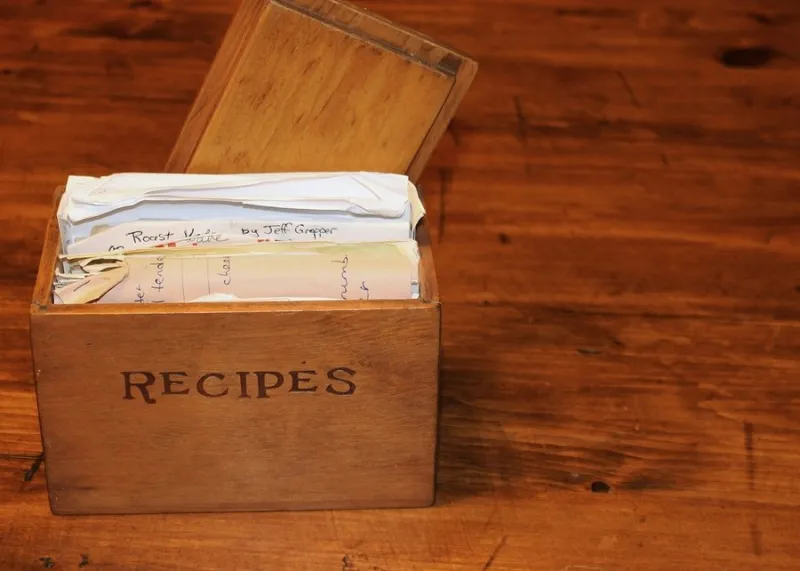
Photo: vintage handwritten recipe cards old wooden box family heirloom wartime, via vintagerecipeproject.com
Most of us inherit things we don't fully understand. Old furniture with unknown histories. Photographs of people nobody can name anymore. The accumulated domestic record of a life, which looks like clutter until it suddenly doesn't.
For a woman named Catherine — she's asked that her last name be kept out of it, which, given what she stumbled into, seems entirely reasonable — the inheritance was a recipe box. Handwritten cards, a few cut-out newspaper clippings, the kind of collection that suggests a person who cooked seriously and saved things. Her grandmother had emigrated from the Netherlands to the United States after the war, settled in Ohio, raised a family, and died in her nineties without, as far as anyone knew, any particular secrets.
Catherine almost donated the box without opening it.
What Almost Got Recycled
The recipe cards themselves were unremarkable — Dutch baking traditions, wartime substitution notes, a few American recipes her grandmother had collected after arriving stateside. What caught Catherine's attention, eventually, was the loose material stuffed behind the cards. A small sheaf of papers, folded many times, written in a cramped hand that mixed Dutch with what appeared to be French and occasional German phrases.
They looked, at first glance, like grocery lists. Quantities of things. Dates. Occasional names that might have been suppliers or neighbors. The kind of mundane administrative record that accumulates in any household and means nothing to anyone outside it.
Catherine, who has a background in library science, didn't throw them away. She scanned them instead, filed the scans, and put the originals back in the box, which went onto a shelf where it sat for another two years.
The scans sat in a folder on her computer labeled, straightforwardly, grandma papers.
The Researcher Who'd Been Looking for Exactly This
The story might have ended there — another family archive quietly gathering digital dust — except that Catherine, cleaning out her hard drive one afternoon, posted a few of the scans to a genealogy forum asking if anyone could help her make sense of the handwriting. She wasn't expecting much. She got considerably more than she bargained for.
Within 48 hours, she had a message from a historian at a Dutch university who had spent fifteen years researching a specific resistance cell that operated in the southern Netherlands during the German occupation. The cell — known in the historical record by a single operational code name — had been extensively documented in postwar testimony, but a significant portion of its communication records had never been located. The network had used a courier system that embedded operational information inside ordinary domestic correspondence: shopping lists, recipe exchanges, household accounts. The genius of it was that it looked exactly like what it claimed to be.
The historian recognized Catherine's scans immediately. The format, the specific combination of languages, the dating conventions — they matched the known signature of the missing correspondence almost precisely.
What the Grocery Lists Actually Said
The decoding process took months and involved multiple specialists. What emerged was a partial but historically significant record: movement information for people being sheltered, supply requests routed through civilian networks, and — most importantly — several documents that corroborated testimony that had previously been considered unverifiable.
For historians of the Dutch resistance, this was substantial. The cell in question had been responsible for sheltering dozens of people over several years of occupation, and questions about the network's reach and methodology had remained open precisely because so much of its operational record had been destroyed or dispersed. What Catherine's grandmother had carried out of the Netherlands — apparently without fully understanding the significance of what she was preserving, or perhaps understanding it very well and choosing never to speak of it — filled in gaps that had frustrated researchers for decades.
Catherine's grandmother had been a courier. That much became clear from the documents themselves and from follow-up research into her wartime biography. What remained unclear, and what Catherine says she has made peace with not knowing, is whether the older woman had deliberately preserved the papers as a historical record, or whether they had simply traveled with her the way things do — tucked into the back of a box, carried across an ocean, surviving by accident.
The Particular Strangeness of Ordinary Objects
Catherine was invited to the Netherlands in connection with the research. She brought the original papers. She stood in a museum where some of them are now displayed, behind glass, next to documentation of the network they helped reconstruct.
She's said in interviews that the experience was disorienting in a specific way. She'd known her grandmother as someone who made very good appelgebak and kept a tidy house and never talked much about the war. The woman in the documents — the one moving information through occupied territory, the one who apparently decided to carry a small piece of that history quietly across the Atlantic and store it behind her butter cake recipe — was someone she was only just beginning to understand.
The recipe box is back on Catherine's shelf. She's kept it.
The thing about inherited objects is that they hold exactly as much as the person who made them chose to put inside — and sometimes, if you don't throw them out, they eventually tell you.