His Memory Was Gone. His Dog Wasn't Ready to Accept That.
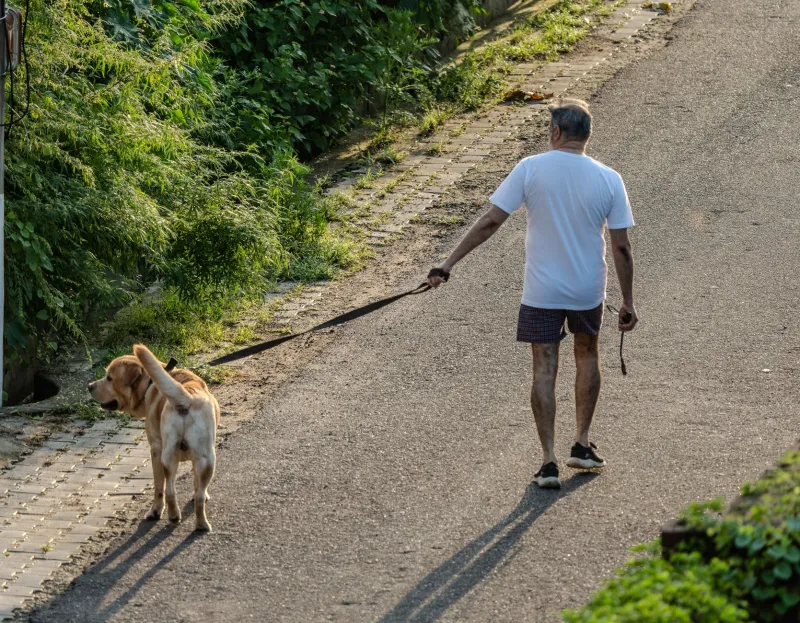
Daniel Reyes spent twelve years in the Army. He was the kind of person who kept his boots polished out of habit even after he came home, who still woke before sunrise most mornings, who had a precise and ordered way of moving through the world. Then a roadside explosion in his third deployment took some of that precision away, and a subsequent fall during his recovery took most of what remained.
By the time Daniel was medically discharged and settled into a small house in central Texas with his wife and a yellow Labrador retriever named Colt, his memory had become a landscape full of gaps. Not total amnesia — he knew his wife's face, knew how to make coffee, could follow a conversation. But the connective tissue of his own life story had been badly damaged. Names escaped him. Dates were unreliable. He would sometimes look at photographs of himself from before the injury and feel nothing — not sadness, just blankness, like looking at a stranger.
Colt had been trained as a psychiatric service dog, primarily to help with Daniel's PTSD. He was good at the job. Calm, attentive, reliably responsive to commands.
Until, one day, he wasn't.
The Dog Stops Listening
The first time it happened, Daniel thought Colt was just having an off day. They were on their usual morning walk through the neighborhood when the dog stopped at an intersection he normally passed without hesitation. He sat down and wouldn't move.
Daniel gave the command to continue. Colt looked at him but didn't budge. Daniel tried again. Nothing. After a few minutes, the dog stood up — but instead of continuing the usual route, he turned left, down a street Daniel never walked.
Daniel followed, more out of curiosity than anything else.
Colt led him four blocks to a small community park Daniel had no memory of ever visiting. The dog walked directly to a bench near a fountain and sat down again, tail moving slowly, watching Daniel with an expression that Daniel later described to his neurologist as purposeful.
Daniel sat on the bench. And something strange happened.
A fragment of memory surfaced — brief, incomplete, but real. He and his wife, early in their marriage, sitting somewhere near water. He couldn't hold onto it. But it had been there.
It Kept Happening
Over the following weeks, Colt's detours became a pattern. He would divert from established routes to lead Daniel to specific locations: a diner on the edge of town, a hardware store, a particular stretch of road near a small airfield outside the city. Each time, Daniel experienced something — a flash, a fragment, an emotional residue he couldn't fully identify.
His wife began keeping a journal of the locations and what Daniel reported feeling at each one. When she brought it to Daniel's neurologist, the doctor was initially skeptical. Service dogs are trained to respond to their handlers' cues, not the other way around. The assumption was that Daniel was unconsciously signaling something — a subtle behavioral change, a shift in breathing or gait — and Colt was responding to that.
But the more the neurologist looked at the journal, the more an alternate possibility took shape.
A Diagnosis Hidden in the Pattern
The locations Colt was leading Daniel to weren't random. Cross-referenced with the fragments of memory Daniel reported at each site, they formed a coherent emotional map — places that carried strong personal significance from before his injuries. The diner was where he and his wife had their first date. The hardware store was where he'd worked summers during high school. The airfield was where his father, a private pilot, had taken him flying as a kid.
Colt wasn't wandering. He was navigating by something.
The neurologist ordered a more comprehensive evaluation than Daniel had previously received, including a specific set of imaging tests that hadn't been part of his original post-injury workup. What the scans revealed was a form of small vessel cerebrovascular disease — damage to tiny blood vessels in the brain that had been compounding quietly since his initial injury. It was treatable. Not reversible, but manageable in ways that could meaningfully slow its progression.
More remarkably, the imaging also showed that Daniel's episodic memory — the system responsible for personal, autobiographical recollection — was more intact than his clinical presentation had suggested. The memories weren't gone. They were, in the neurologist's words, access-impaired. The emotional charge attached to specific places was functioning as an alternate retrieval pathway.
Colt, somehow, had been finding those places.
What the Dog Knew
The scientific explanation, once the team dug into it, was grounded in well-documented animal behavior research. Dogs are extraordinarily sensitive to changes in human physiology — heart rate, cortisol levels, micro-expressions, shifts in movement patterns. It's why they can be trained to detect seizures, drops in blood sugar, and acute anxiety episodes before their handlers are consciously aware of them.
The working theory is that as Daniel approached locations carrying strong emotional memory, his body responded in ways he wasn't consciously registering — but Colt was. The dog had learned, over months of close contact, to associate those subtle physiological signals with something meaningful. He wasn't leading Daniel anywhere. He was following Daniel's body to places Daniel's mind couldn't find on its own.
It's not a mystical explanation. It's a biological one. But it doesn't make the story any less remarkable.
The Reunion
Daniel began a targeted treatment protocol shortly after his diagnosis. His memory hasn't fully recovered — it likely never will. But the gaps have stabilized, and some of what was lost has become more accessible over time.
He still walks with Colt every morning. He still lets the dog choose the route sometimes.
"He's gotten me home more times than I can count," Daniel told one of his therapists. "In more ways than one."
The irony, of course, is that the brain injury had taken so much of Daniel's ability to remember his own life — and it was an animal, operating on pure instinct and an unbreakable bond, that quietly started leading him back to it.