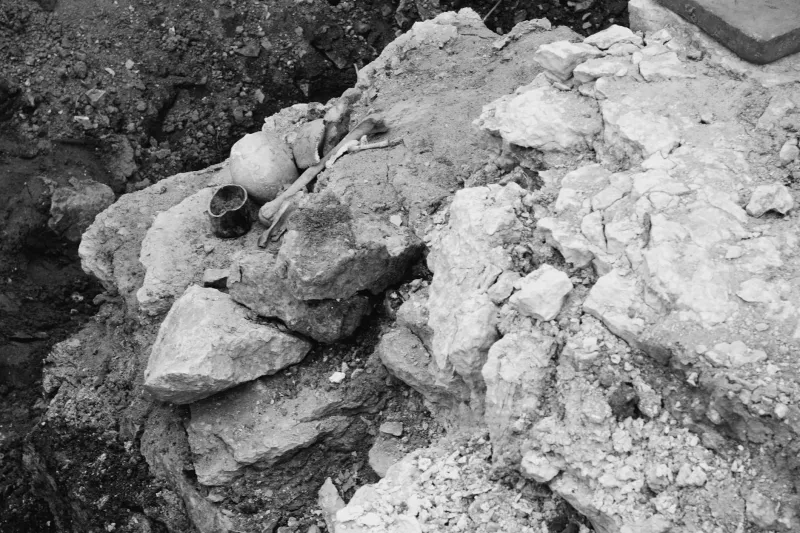
When the Earth Gives Up Its Secrets
In the spring of 1923, Walter Johnson was having a typical Kansas farming day — until his plow struck something that definitely wasn't a rock. The metallic scraping sound that rang across his cornfield near Lyons would eventually rewrite American history, though it took nearly a century for anyone to realize it.
What Johnson had uncovered were fragments of pottery, stone tools, and metal artifacts that belonged to one of the largest pre-Columbian cities ever discovered in North America. But in 1923, a Kansas farmer had crops to plant and bills to pay. The strange objects went into a box, the box went into a barn, and one of archaeology's greatest discoveries went back to sleep under the prairie soil.
The City That Time Forgot
The artifacts Johnson found belonged to Etzanoa, a sprawling Native American metropolis that flourished around 1450 AD along the Arkansas River. At its peak, this indigenous city housed an estimated 20,000 people across 5 square miles — making it larger than medieval London and rivaling the great cities of Europe in both size and sophistication.
Etzanoa wasn't just big; it was strategically brilliant. The settlement controlled a crucial bend in the Arkansas River where multiple trade routes converged. Archaeological evidence suggests residents engaged in commerce stretching from the Great Lakes to the Gulf of Mexico, trading everything from copper and shells to exotic feathers and precious stones.
The city featured planned neighborhoods, sophisticated agricultural systems, and defensive earthworks that protected against both floods and enemies. Its residents built impressive structures using a combination of wood, stone, and packed earth that could house extended families and serve as community gathering spaces.
The Academic Blind Spot
Why did it take so long to recognize Etzanoa's significance? The answer reveals uncomfortable truths about American archaeology and education. For generations, textbooks taught that the Great Plains were sparsely populated before European contact — a narrative that conveniently justified westward expansion and minimized the complexity of Indigenous civilizations.
When Spanish conquistador Francisco Vázquez de Coronado passed through the area in 1541, he described a massive settlement he called "the great settlement." His accounts mentioned thousands of inhabitants, impressive architecture, and abundant resources. But historians dismissed these descriptions as exaggerations, assuming Coronado was embellishing his reports to impress his superiors back in Spain.
This academic skepticism meant that when farmers like Johnson found artifacts, there was no institutional framework to recognize their significance. Universities weren't looking for major Indigenous cities on the Great Plains because they'd already decided none existed.
High School Heroes
The story might have ended there, with Etzanoa remaining a forgotten footnote in some farmer's barn. But in 2017, a group of Arkansas City High School students participating in a Kansas Historical Society program decided to investigate local archaeological sites.
Guided by historian Donald Blakeslee from Wichita State University, these teenagers began systematically surveying the area around Lyons using ground-penetrating radar, metal detectors, and careful excavation techniques. What they found stunned professional archaeologists: evidence of a settlement so vast and sophisticated that it challenged fundamental assumptions about pre-Columbian North America.
The students' work revealed defensive earthworks, residential areas, and artifact concentrations spanning thousands of acres. Carbon dating confirmed the site's age, while analysis of pottery styles and trade goods established connections to other major Indigenous centers across the continent.
Rewriting the Textbooks
The Etzanoa discovery forced a complete reconsideration of Great Plains history. Here was proof that Indigenous peoples had built major urban centers, developed complex trade networks, and sustained large populations centuries before European contact. The city's sophisticated agricultural systems had supported population densities comparable to European cities of the same period.
Moreover, Etzanoa's decline appeared to coincide with the arrival of European diseases in the 16th century — not through direct contact, but via trade networks that carried both goods and pathogens across vast distances. The city that had thrived for centuries was likely devastated by smallpox and other diseases decades before any European set foot in Kansas.
The Cornfield Revelation
Perhaps the most remarkable aspect of this discovery is how it was hiding in plain sight. For nearly a century, farmers plowed over one of America's greatest archaeological treasures, unknowingly disturbing artifacts that could have revolutionized our understanding of Indigenous history.
The Johnson family farm, where it all began, continued operating throughout the 20th century. Generations of farmers worked the same fields where thousands of people once lived, traded, and built a civilization. The irony is profound: America's agricultural heartland was literally built on top of another agricultural civilization that had worked the same soil centuries earlier.
What Lies Beneath
Today, much of Etzanoa remains unexcavated, protected under modern farmland and private property. Archaeologists estimate they've uncovered less than 1% of the total site, meaning countless discoveries still lie beneath Kansas corn and wheat fields.
The story raises tantalizing questions about what other archaeological treasures might be hidden under America's agricultural landscapes. If a city the size of Etzanoa could remain essentially unknown for 500 years, what other Indigenous civilizations are waiting to be rediscovered?
The Farmer's Legacy
Walter Johnson never lived to see his accidental discovery recognized for what it was. He died in 1967, probably never knowing that his plow had struck artifacts from one of North America's greatest cities. But his decision to save those mysterious objects — rather than throwing them away as curiosities — preserved crucial evidence for future generations.
The Etzanoa discovery serves as a reminder that history is literally all around us, waiting to be uncovered by anyone curious enough to pay attention. Sometimes the most extraordinary discoveries happen not in exotic locations, but in the most ordinary places — like a Kansas cornfield on a spring morning when a farmer's plow strikes something that shouldn't be there.