The Mayor Who Wouldn't Leave Office
In most places, death is a pretty definitive end to a political career. But in Riverside, Iowa—a town of barely 1,000 people famous for claiming to be the future birthplace of Star Trek's Captain Kirk—the rules of mortality apparently don't apply to local elections.
Between 2018 and 2024, Mayor Harold "Hank" Peterson won three consecutive mayoral races despite being certifiably dead since March 2016. The first victory could be explained away as a clerical error. The second raised eyebrows. By the third, Riverside had become the unwitting poster child for everything weird about American election law.
How to Win an Election from Beyond the Grave
Peterson's posthumous political career began innocuously enough. The 67-year-old farmer-turned-mayor had served Riverside faithfully for twelve years when he suffered a heart attack while fixing a fence on his property. His death occurred just three weeks after the filing deadline for the 2018 mayoral election, leaving election officials in an impossible bind.
Under Iowa law, removing a candidate's name from the ballot after the printing deadline requires a court order—a process that can take weeks and cost thousands of dollars. For a town operating on a shoestring budget, reprinting ballots seemed like an unnecessary expense, especially since Peterson was running unopposed.
"We figured people would just write in someone else," explained then-City Clerk Martha Hendricks. "Seemed like common sense."
Common sense, however, proved to be in short supply.
The Voters Speak (for the Dead)
On election day 2018, something remarkable happened: 847 of Riverside's 923 registered voters cast their ballots for the deceased Peterson. Only 31 people bothered to write in living alternatives, while the rest apparently decided that death was no barrier to effective municipal leadership.
"Hank was a good mayor," local hardware store owner Bill Kowalski told reporters after the election. "Just because he's dead doesn't mean he stopped being good at the job."
The Iowa Secretary of State's office scrambled to address the situation, ultimately declaring the election invalid and scheduling a special election for six months later. But when filing time came around again, something even stranger happened: nobody bothered to run.
The Persistence of Posthumous Popularity
By 2020, Peterson's name was back on the ballot—not through any supernatural intervention, but because the town council, facing another candidate shortage, simply reused the previous election's paperwork. This time, Peterson won by an even larger margin: 891 votes out of 934 cast.
"At that point, we figured the voters had made their preference clear," said current City Clerk Jennifer Walsh, who inherited the position when Hendricks moved to Florida in apparent frustration with Iowa's electoral system.
The pattern repeated in 2022 and again in 2024. Each time, state officials would declare the election invalid, appoint a temporary administrator, and eventually hold a special election that typically attracted fewer than 100 voters. Meanwhile, Peterson's approval ratings remained remarkably stable for a dead man—consistently polling above 85% in local surveys.
The Legal Limbo of Dead Democracy
Peterson's electoral success exposed a glaring loophole in American election law: while federal and state regulations prohibit dead people from taking office, they don't explicitly prevent them from winning elections. The result is a legal gray area where deceased candidates can technically be elected but cannot legally serve.
"It's the kind of situation that makes law professors wake up in cold sweats," explained Dr. Sarah Chen, who studies election law at the University of Iowa. "We have a democratically elected official who is constitutionally incapable of governing. It's like democracy's version of a philosophical paradox."
The situation has prompted at least three attempts at state-level legislation to prevent dead candidates from appearing on ballots, but each effort has stalled in committee. Critics argue that such laws could disenfranchise voters who prefer deceased candidates to living alternatives—a concern that sounds absurd until you remember that Riverside voters had eight years to choose someone else.
The Town That Time (and Death) Forgot
Today, Riverside continues to function under a series of appointed interim mayors while Peterson's name remains on voter rolls. His official city email account still receives constituent complaints, which are forwarded to whoever happens to be running things that week.
The town has embraced its unusual claim to fame, selling t-shirts reading "Riverside: Where Democracy Never Dies" and hosting an annual "Posthumous Politics Festival" that draws curious visitors from across the Midwest.
As for Peterson himself, he rests peacefully in Riverside Cemetery, presumably unaware that he's won more elections dead than most politicians manage while alive. His gravestone, recently updated by admirers, now reads: "Harold Peterson, 1949-2016, Mayor for Life (and Beyond)."
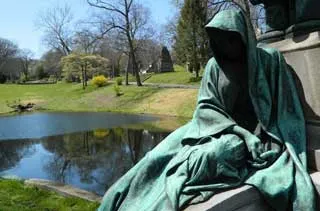 Photo: Riverside Cemetery, via riversidecemeteryct.org
 Photo: Harold Peterson, via pictures.abebooks.com
In a world where political careers often seem to survive scandals, corruption, and complete incompetence, perhaps it shouldn't surprise us that one small Iowa town decided that death was just another campaign obstacle to overcome.