When Death Certificates Were Wrong: The American Farmers Who Crawled Out of Their Own Graves
When Death Certificates Were Wrong: The American Farmers Who Crawled Out of Their Own Graves
Imagine attending your own funeral, watching friends and family weep over your coffin, knowing you're very much alive but unable to convince anyone. For several Americans in the 19th and early 20th centuries, this nightmare scenario became reality — and for some unlucky souls, it happened more than once.
The Problem with 19th Century Death
Before stethoscopes became standard medical equipment and understanding of comas improved, determining death was shockingly primitive. Doctors relied on basic observations: no visible breathing, no detectable pulse, and cold skin. In rural America, where trained physicians were scarce, the task often fell to local officials with no medical training whatsoever.
This led to a peculiar problem that plagued American communities for decades: premature burial. The fear became so widespread that wealthy families began installing bells in coffins, connected by strings to the buried person's hand. The phrase "saved by the bell" actually originated from this macabre practice.
The Case of Jenkins McReady
In 1887, Missouri farmer Jenkins McReady became perhaps the most documented case of multiple "resurrections" in American history. After collapsing during harvest season, the 34-year-old was examined by the local doctor, who declared him dead from what appeared to be a heart attack.
McReady was laid out for viewing in his farmhouse parlor, as was customary. But during the wake, his wife noticed his hand had moved. When she called for help, skeptical neighbors dismissed it as her imagination — until McReady sat up and asked for water.
The town was stunned, but chalked it up to medical error. McReady returned to farming, becoming something of a local celebrity. Newspapers as far as St. Louis picked up the story of the "man who came back from the dead."
Lightning Strikes Twice
Three years later, McReady collapsed again. This time, the same doctor was more thorough, checking for breath with a mirror and testing for pulse at multiple points. Finding none, he signed the death certificate with confidence.
McReady's funeral was held two days later. The service had just begun when mourners heard knocking from inside the coffin. This time, the congregation fled in terror, convinced they were witnessing something supernatural. Only the preacher and McReady's wife remained to open the coffin.
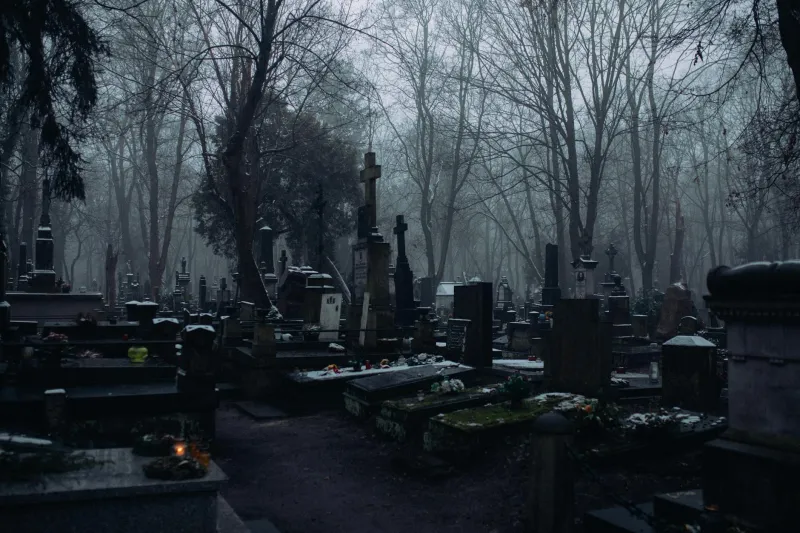
McReady lived another 23 years, dying peacefully in his sleep in 1913. His tombstone, still visible in Hannibal Cemetery, reads: "Third time's the charm."
The Medical Mystery
What caused these bizarre resurrections? Modern medical experts believe McReady likely suffered from a rare condition called catalepsy, which can cause temporary paralysis and dramatically slow vital signs. The condition was poorly understood in the 19th century and often mimicked death closely enough to fool even trained physicians.
Dr. Sarah Whitman, a medical historian at Washington University, explains: "What we're seeing in these cases is probably a combination of catalepsy, severe hypothermia, and the primitive diagnostic tools of the era. The human body can survive in states that appear death-like to the untrained eye."
A National Phenomenon
McReady wasn't alone. Newspaper archives from the late 1800s are filled with similar stories across rural America. In 1891, a Texas rancher named William Porter was declared dead three times over two decades. Each time, he recovered just before burial.
In Ohio, Emma Hartley was pronounced dead twice in the same month after suffering seizures. Her family eventually refused to bury her until a full week had passed, leading to the local saying: "Don't bury Emma on a Tuesday."
These cases led to significant changes in American burial practices. By the early 1900s, most states required a 24-hour waiting period before burial, and embalming became standard practice — partly to prevent the embarrassment of burying someone alive.
The Legal Chaos
Being declared dead created bizarre legal complications. McReady's first "death" invalidated his property rights, forcing him to prove his identity in court to reclaim his own farm. His wife had already begun receiving widow's benefits from the local church fund.
"Imagine trying to explain to a judge that you're not dead when the official record says otherwise," notes legal historian Mark Davidson. "These cases created unprecedented challenges for American courts."
Legacy of the Living Dead
The phenomenon of premature burial scares eventually led to significant medical advances. The invention of the modern stethoscope was partly motivated by doctors' need to detect faint heartbeats. Hospitals began requiring multiple physicians to confirm death.
Today, brain death protocols and advanced monitoring make such errors virtually impossible. But the stories of McReady and others serve as a reminder of how recently death remained mysterious — and how thin the line between life and death really was.
The next time you hear someone say they "feel dead," remember Jenkins McReady. He actually was dead — officially, anyway — and lived to tell about it. Twice.