
When Math Goes Wrong, Towns Disappear
In 1847, the residents of Perdition, Missouri went to bed as Missourians and woke up as... nobody knew what. A surveying crew's miscalculation had literally erased their town from Missouri and accidentally grafted it onto Iowa, creating a legal nightmare that wouldn't be resolved for four decades.
 Photo: Perdition, Missouri, via perditiontemple.com
The mistake happened during the Great Western Survey, a massive federal project to establish precise state boundaries across the expanding frontier. Surveyor Thomas Wickham's team was tasked with marking the Missouri-Iowa border using astronomical observations and mathematical calculations. But when Wickham's assistant misread a crucial measurement by exactly 1.2 miles, he inadvertently redrew state lines around the 300-person farming community.
The Morning Everything Changed
Nobody noticed the error immediately. The surveying stakes looked identical to the old boundary markers, and the actual border was just an invisible line running through cornfields and pastures. It wasn't until tax season arrived that Perdition's residents discovered their peculiar predicament.
Missouri tax collectors arrived in spring 1848 to find that Perdition was no longer on their maps. According to the new official survey, the town sat squarely in Iowa territory. But Iowa's territorial government insisted they had never authorized the addition of a Missouri settlement to their jurisdiction. Perdition existed in both states and neither.
Living in Legal Limbo
For the next 40 years, Perdition's residents found themselves trapped in bureaucratic purgatory. They couldn't vote in Missouri elections because they weren't Missouri residents. They couldn't vote in Iowa because Iowa didn't recognize them as citizens. Their marriages weren't legally valid in either state. Their property deeds existed in a legal gray zone.
Most bizarrely, both states continued demanding taxes. Missouri claimed the residents owed back taxes as former citizens. Iowa insisted they owed current taxes as new residents. Many families paid double taxes for decades rather than risk having their property seized by either state.
The Two-State Solution
Rather than abandon their homes and farms, Perdition's residents developed creative workarounds for their impossible situation. They established their own unofficial government, with a mayor who served as liaison to both state capitals. They created a unique dual-citizenship system where residents could choose which state's laws to follow for different aspects of their lives.
Want to get married? Follow Missouri's more lenient marriage laws. Need to file a business license? Iowa's territorial regulations were simpler. Facing criminal charges? Whichever state offered a better deal.
This legal flexibility attracted an unusual population of entrepreneurs, fugitives, and free-thinkers who appreciated living beyond the reach of conventional authority. By the 1860s, Perdition had become a minor Wild West destination, known for its gambling halls, unconventional marriages, and general disregard for state regulations.
The Surveyor's Return
The solution came from an unexpected source. In 1887, Thomas Wickham — now 73 and long retired — read a newspaper article about Perdition's ongoing predicament. Recognizing his original mistake, he volunteered to conduct a new survey at his own expense.
Using improved instruments and calculation methods, Wickham's team spent three months re-measuring the border. Their findings were definitive: Perdition belonged to Missouri, exactly where it had always been. The 1847 survey had indeed been wrong, off by exactly 1.2 miles due to a transcription error in the field notes.
Bureaucracy Moves Slower Than Glaciers
Proving the error was one thing; fixing it was another. Both state governments had built 40 years of legal precedent around the incorrect border. Iowa had collected taxes from Perdition residents. Missouri had written them off as lost territory. Neither state wanted to unravel decades of paperwork.
The resolution required a special joint legislative session between Missouri and Iowa, federal mediation, and ultimately an act of Congress to officially "return" Perdition to Missouri. The process took another two years, meaning the town's legal exile lasted 42 years total.
The Price of Precision
When Perdition finally rejoined Missouri in 1889, the celebration lasted three days. But the homecoming came with a steep price. Missouri demanded 42 years of back taxes, penalties, and interest. Many families faced financial ruin from the accumulated debt.
The crisis was resolved only when the federal government agreed to compensate Missouri for the lost tax revenue, treating Perdition's situation as a surveying error covered under the government's liability for mapping mistakes.
Modern Border Security
Perdition's story led to significant reforms in how America establishes and maintains state boundaries. The incident highlighted the need for redundant measurements, peer review of survey calculations, and regular verification of boundary markers.
Today, GPS technology and satellite mapping make such errors virtually impossible. But Perdition's 42-year exile remains a cautionary tale about the real-world consequences of bureaucratic mistakes.
Where Perdition Stands Today
The town that was accidentally erased from the map still exists, now called Redemption, Missouri. (The name change occurred in 1889 as part of the homecoming celebration.) A historical marker on Main Street commemorates the "Great Border Blunder," and the town's annual Stateless Days festival draws visitors from across the Midwest.
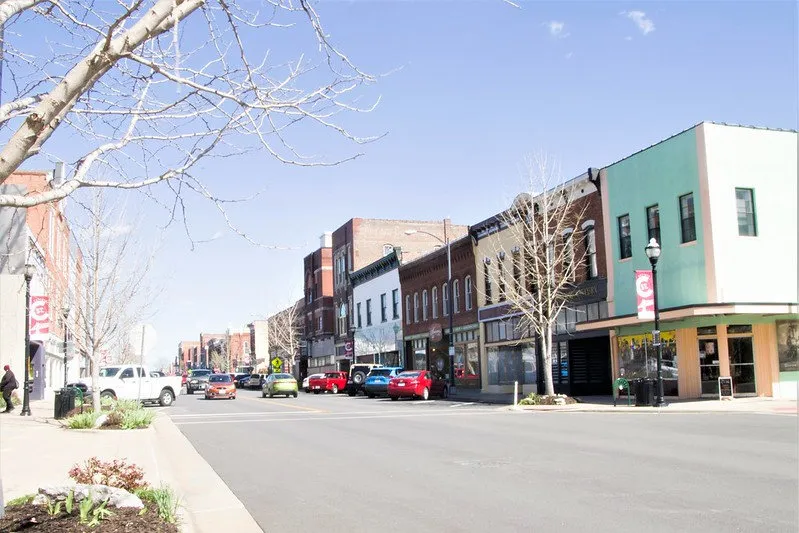 Photo: Redemption, Missouri, via static.wixstatic.com
The festival's motto captures the community's hard-won wisdom: "Sometimes the best place to be is nowhere at all."